
William .H. Anderson
Born in Mexico, Indiana in 1870, Anderson William Harrison was graduated from Battle Creek College in absentia in 1895.
This was because of the urgent need for missionaries to be sent to Africa as explained to him in a letter by F. M Wilcox. He accepted the call and was appointed to the advisory board alongside elder G. B Tripp and Dr A. S Carmichael.
He was married to Nora Haysmer prior to his calling and they left New York for Africa on the 10th of April 1895 arriving on May 9th the same year. They traveled six weeks inland from South Africa and arrived at the site of Solusi Mission on an ox wagon as the railroad had not been built. The missionaries arrived to the mission with a bunch of challenges in waiting. In the following year, locusts swarm in feeding on the plantations set by the missionaries who had barely settled. In the rainy season of that same year, the torrents had made it hard for the missionaries to do any meaningful work.
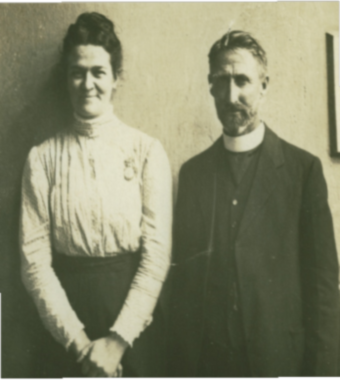
Nora and William Anderson
The structures were weakened with part of Andersons’ mud wall house collapsing to bury his newly made stove in inches of mud. Rinderpest hit the cattle in the country bringing down the population from over 100,000 heads to just 500. It is in the same year that the infamous Matembele war broke leading to a six month siege. In the time of the siege, elder Anderson and elder Tripp took turns to go out and seek provisions for the mission which was cut from the rest of the country by Matebele warriors roaming the region. In one such trips, elder Anderson bought a few donkeys seeing it could have been easier for him to ride than walk. He then packed all the supplies he could get and headed for the mission only for the donkeys to start braying loud as if alerting the rebels of his presence. He took off and ran through the bushes to the mission. Luckily, after about one hour, his African assistants delivered the donkeys and the supplies to the mission.
At the end of the six month long siege that ended in July of 1896, Anderson sent his African assistant with an ox wagon to Bulawayo to fetch the missionaries wives who had taken refuge there. At that time ,the war had abated and it was relatively safe for the the wives to return to the mission as the Matebele presence in he area had faded. The rebels had moved out. The war left many mission centers burnt and looted save for Solusi. The charter company in Rhodesia was contacted to assist with supplies for upkeep of the mission without much success. After a while however, Anderson came in from Bulawayo with oxen carts loaded with food donated by the government. The government finally extended a helping hand.
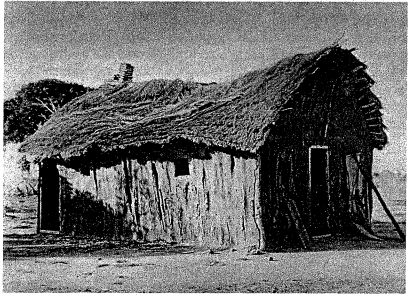
William Anderson’s house.
However, times were only beginning to get bad. Work at the mission was getting harder and this prompted Anderson to write to the Foreign Mission Board with his letter signed off ,’ we must get help’. Unfortunately, there was barely any funds in the treasury of the Foreign Mission Board. Nonetheless the editor of Review appealed to the christian population in America saying, ‘ we invite those with pleasant homes and well dressed little ones to remember the children mentioned by Elder Anderson and send them help.’
Elder Anderson invited John Ntaba to the mission school to teach the Africans. He wanted a native who could take charge of the mission school and Ntaba was the best he could find despite the man’s bad drunkenness habit. Ntaba was a native of Natal and had acquired education in a mission school.
Hence Anderson and Ntaba designed a program for teaching the students. Due to the lack of resources and books, Ntaba used the bible as a text book, the song book as a guide to English language and the students learnt to write by markings in the sand.Ntaba’s own son, Albert Lutuli, born at Solusi, went ahead to become a great teacher, a chief and and even won the Nobel Peace price of the year 1960. Anderson was proficient in Sendebele language and he served as an interpreter to the guests who visited the mission such as elder Olsen and Dr Lindsay who visited the mission. When John Ntaba passed away, Anderson and his wife , Nora, took charge of the mission school and taught the students. It was a burden as most of the missionaries had either left the mission or succumbed to Malaria or fever. The period between 1897 and 1898 was a hectic time for the Andersons as they were the only missionary workers left at Solusi. The mission work was theirs and theirs alone to bear. This went on until a team of missionaries were sent in to help the Andersons. F.L Mead, H. A Green , G. J Lloyd, Hiva Starr and J. A Chaney was the team that departed from New York towards the end of 1898 arriving at the mission on April 5th 1899.
In 1903 the Andersons left Solusi for a furlough returning in 1905 to cross the Zambezi river , proceeding North east and setting up the Rusangu Mission. He pioneered missionary work in 1919 in Bechuanas and opened missionary work in Angola in 1922, establishing other missionary stations in the subsequent years. He was at the golden Jubilee in 1944 at Solusi and departed for America after doing mission work in Africa for more than 50 years. ‘On the Trail of Livingstone’ , a book he wrote , was instrumental in giving missionaries a perspective of the African continent.